
Despite the growth of renewable energy, hydrocarbon fuels are expected to continue supplying a large fraction of global energy demand. Enhanced Oil Recovery (EOR) techniques optimise fluid behaviour, alter reservoir conditions, and recover additional oil from marginal fields at reduced energy consumption. In so doing, EOR contributes to sustainable energy solutions while maximising oil production.
EOR involves injecting recovered water, usually with a high brine content, into an oil reservoir to recover entrained oil reserves. Often chemicals are injected to change the mobility of the displacing fluid. Chemical EOR methods aim to reduce overall energy requirements for extracting oil. One such method involves injecting polymers into oil reservoirs. Compared to water flooding, a secondary production method, polymer flooding increases energy efficiency due to smaller water circulation loads.
The injected chemicals typically consist of polymers to increase the viscosity of the displacing solution. It may also include surfactants or alkalis. Surfactants lower interfacial tension, thus improving the wettability of porous rocks. Alkali chemicals react with certain types of oil to form surfactants.
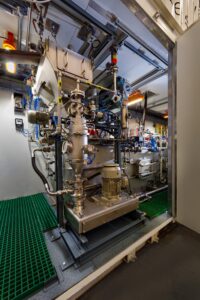
ProProcess’s focus on chemical EOR aligns with the industry’s need for greener and cleaner energy solutions. The company has designed and patented a dynamic wetting head that ensures its customised EOR plants have a guaranteed uptime of 95%. “Traditionally, these plants were difficult to maintain, necessitating the addition of expensive standby units,” comments Tanja Marcus, Process Lead at ProProcess. Its plants, on the other hand, recorded 2 500 hours of uptime and uninterrupted running time in November 2023, for example.

“We are an independent equipment supplier offering world-class enhanced oil recovery equipment solutions. We offer both a standard polymer injection and customised solutions, depending on the application. Our modular EOR process plants provide clients with the scalability and flexibility required,” explains Marcus.
The additional benefit of ProProcess’s technology is that it allows for a higher polymer concentration over ejector-type applications, translating into a smaller footprint of the overall plant and hence a reduced cost and increased return on investment. Crucially, EOR methods enhance oil production from existing marginal oil fields. These fields often still contain around 50% of unrecovered crude oil. By employing EOR from ProProcess, clients can tap into this remaining resource efficiently and economically.
Polymers exhibit viscoelastic properties, making them effective in altering fluid flow behaviour within reservoirs. This property aids in improving sweep efficiency and displacing oil from pore spaces. The chemistry underlying polymer synthesis ensures effective interaction with reservoir fluids and rock surfaces. This optimisation results in improved oil recovery rates. Implementing EOR – including the use of polymers, surfactants, alkali, and emulsions – has shown promising results in economically recovering additional oil from marginal oil wells.
By accurately selecting polymer preparation methods, ProProcess contributes to decreasing carbon dioxide emissions during oil extraction. It provides independent polymer make-down testwork, tailoring pilot plants or commercial units to specific client requirements. “EOR solutions from ProProcess provide a sustainable pathway to maximise oil recovery while aligning with the industry’s broader goal of cleaner energy solutions,” concludes Marcus.


Contact details – Tanja Marcus
Email – tanja.marcus@ppeps.com
Telephone – +27 (11) 568 2092
REFERENCES:
Polymers for enhanced oil recovery: fundamentals and selection criteria https://link.springer.com/article/10.1007/s00253-021-11618-y.
Application of Polymers for Chemical Enhanced Oil Recovery: A Review – MDPI. https://www.mdpi.com/2073-4360/14/7/1433.
Chemical Enhanced Oil Recovery | Frontiers Research Topic. https://www.frontiersin.org/research-topics/62112/chemical-enhanced-oil-recovery.
Application of Polymers for Chemical Enhanced Oil Recovery: A Review https://europepmc.org/article/PMC/PMC9003037.